

You're probably in the same place as a lot of UK mattress shoppers. You've seen rolled-up mattresses everywhere, every brand says theirs is supportive and cooling, and half the listings look almost identical. Then doubts start. Are bed in a box mattresses all just foam? Will one help if your lower back aches in the morning? And if you overheat at night, will “cooling” mean anything beyond a nice-sounding label?
Those are fair questions, especially if you're buying without lying on the mattress first. A good bed in a box in the UK isn't just about easy delivery. It's about understanding what's inside the mattress, how it handles support and airflow, and whether the trial period gives you enough time to judge it properly. Cooling pillows matter too, because a breathable mattress can only do part of the job if your head and neck still trap heat.
Table of Contents
- The Rise of the Bed in a Box in the UK
- What a Modern Bed in a Box Is Really Made Of
- The Hybrid Advantage for Back Pain and Hot Sleepers
- Decoding Firmness Airflow and Support Features
- Your Essential Pre-Purchase Checklist
- Unboxing and Surviving the First 30 Nights
- Finding Your Perfect Match and Next Steps
The Rise of the Bed in a Box in the UK
The reason bed in a box shopping took off is easy to understand. It removes the most frustrating parts of traditional mattress buying. You don't need to spend a Saturday walking around showrooms, and you don't need to guess whether a full-size mattress will fit through a narrow hallway or up the stairs.

For many shoppers, the appeal is convenience plus lower-pressure decision-making. You order online, the mattress arrives compacted, and you test it in your own bedroom instead of on a brightly lit shop floor for five awkward minutes. That's a much better way to judge whether a mattress suits your body.
Why the format became so popular
Three things usually drive the decision:
- Easier delivery: A rolled mattress is far simpler to move through tight UK homes and flats.
- At-home trials: Many online brands let you test a mattress over weeks or months instead of making a snap decision.
- Clearer comparison: It's easier to compare construction, firmness, and cooling features when you're not being rushed.
The convenience is real, but so is the confusion. A bed in a box is a delivery method, not a specific feel or material. Some are simple foam builds. Others are much more advanced hybrids with springs, foam, edge support, and cooling fabrics.
A mattress arriving in a box doesn't tell you whether it will feel soft, firm, cool, or supportive. The construction tells you that.
That's a common sticking point. Many assume every boxed mattress will feel like a marshmallow, sleep warm, or lack proper support. Yet current UK sleep shopping trends show just how much attention people are paying to sleep quality and mattress choice, which you can see in these UK sleep statistics from REM-Fit.
What a Modern Bed in a Box Is Really Made Of
Open a typical product page for a bed in a box and you will usually see a long list of foam names, comfort claims, and cooling language. What matters is simpler. You are buying a stack of layers, and each layer has a job.
Many shoppers still picture one big block of foam folded into a carton. A lot of modern UK models are built very differently. Many now use a hybrid construction, which means foam layers on top and a spring support core underneath.
A hybrid mattress works like a good walking boot. The padded upper softens contact with the ground, but the structured sole does the work of keeping you stable over distance. In mattress terms, the comfort layers cushion pressure points, while the spring unit underneath helps stop your body from dropping out of line.
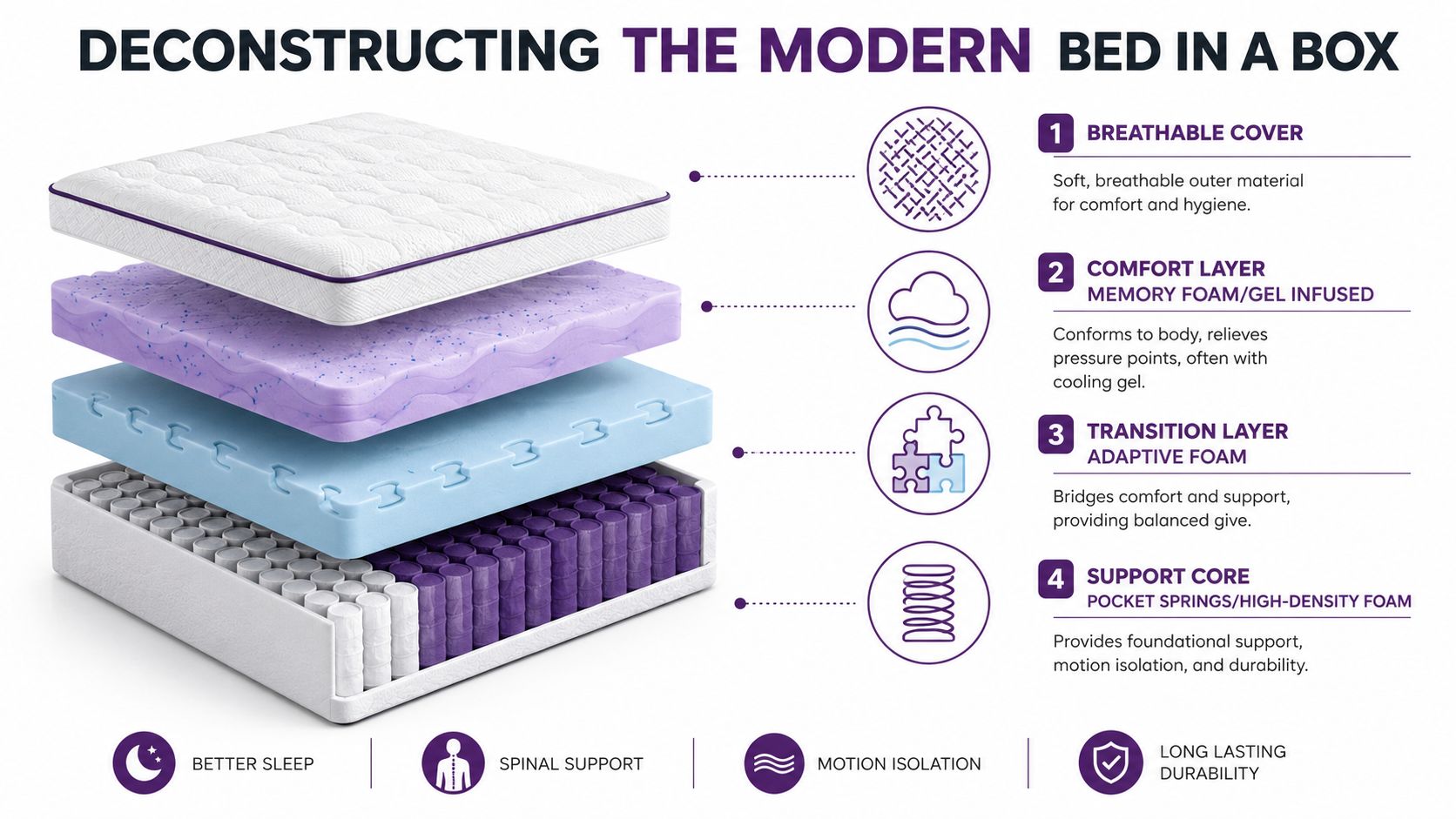
The four parts that matter most
The easiest way to read mattress construction is from top to bottom.
| Layer | What it does | Why it matters |
|---|---|---|
| Cover | Sits on top of the mattress | A breathable cover can help the surface feel less stuffy |
| Comfort layer | Usually memory foam, latex, or gel-infused foam | Cushions shoulders, hips, and joints |
| Transition layer | Sits between comfort and support | Helps you settle into the mattress without sinking too far |
| Support core | Pocket springs or dense foam | Carries most of your body weight and helps keep your spine steadier |
That support core is where many buying mistakes happen.
Shoppers often focus on the first inch or two because it is the part described with the most marketing language. But the deeper layers usually decide whether the mattress still feels supportive after several hours, especially under the hips, waist, and lower back. If the top feels pleasant in the first minute but the base lets your middle sink too much, comfort can turn into stiffness by morning.
Why modern boxed mattresses often use hybrids
Hybrid design solves a practical problem. No single material does every job well. Foam is good at cushioning and reducing pressure at the surface. Springs are better at adding structure, helping air move through the mattress, and giving the bed a less swallowed-up feel when you change position.
That matters for UK sleepers who are trying to solve a specific problem, not just buy a convenient delivery format. A person with back pain usually needs more than softness. A hot sleeper usually needs more than a cool-touch cover. Hybrid construction gives brands a way to split those tasks across different layers instead of asking one foam block to handle all of them.
Materials in the comfort layer still matter, especially if you are comparing slower-moving memory foam with springier alternatives. This latex mattress vs memory foam guide explains how those surface materials tend to feel in real use.
One example from the category is the REM-Fit 400 Hybrid Mattress, which is presented as a hybrid model. The useful takeaway is the construction type itself. A boxed mattress can contain a layered support system with both comfort materials and springs, rather than a single slab of foam.
The Hybrid Advantage for Back Pain and Hot Sleepers
If you wake up stiff, sore, or sweaty, hybrid construction deserves a closer look than standard all-foam beds. For those two complaints in particular, the internal build of the mattress changes the outcome in a very practical way.
Back pain often gets worse when a mattress lets the heavier middle of the body sink too far. Overheating often gets worse when dense materials hold warmth around you instead of letting it move away. Hybrids tackle both issues by splitting support and airflow duties across different layers.
Why support feels different on a hybrid
A spring core pushes back in a more structured way than a deep all-foam base. Pocket springs can respond across different parts of the body, which helps keep your shoulders, waist, hips, and legs from all dropping to the same depth. That matters if you need your spine to stay in a more neutral line overnight.
The gap in the market is bigger than many shoppers realise. Most bed-in-a-box brands in the UK offer limited firmness options, despite 60% of UK adults reporting sleep-related back issues. Data shows that hybrid mattresses with pocket springs outperform all-foam beds by 42% in pressure relief for side sleepers, a critical factor for spinal alignment, according to this analysis of mattress in a box problems in the UK market.
Practical rule: If your pain is worst around the hips, lower back, or shoulders, don't judge a mattress by softness alone. Judge how evenly it holds you up.
That's why generic “medium” labels can be misleading. Two mattresses can both be called medium, but one may use zoning, springs, and stronger edge support while the other is softer foam over a foam base. They won't feel the same after a full night.
Why hot sleepers often prefer springs plus open foam
Air moves more freely through a spring core than through a solid foam block. That gives body heat somewhere to go. Add open-cell foam on top and the mattress usually feels less stuffy, especially if you tend to sleep warm through your shoulders, chest, and head.
Cooling pillows matter here too. If your mattress breathes well but your pillow traps heat around your neck and scalp, you can still wake up clammy. A better setup is a breathable hybrid mattress paired with a cooling pillow that allows air movement and avoids that dense, heat-held feeling around the face.
For shoppers dealing with pressure points, this pressure relief mattress guide gives a useful framework for matching support to common pain patterns.
Decoding Firmness Airflow and Support Features
You can read ten mattress listings and still feel no clearer about what will help you sleep better. That usually happens because brands mix together three different ideas. Firmness, airflow, and support are related, but they are not the same thing, and each one affects your night in a different way.
The easiest way to separate them is this. Firmness is your first impression when you lie down. Support is what keeps your spine from dipping out of line after a few hours. Airflow is what stops the bed from feeling stuffy around your back, chest, and legs.
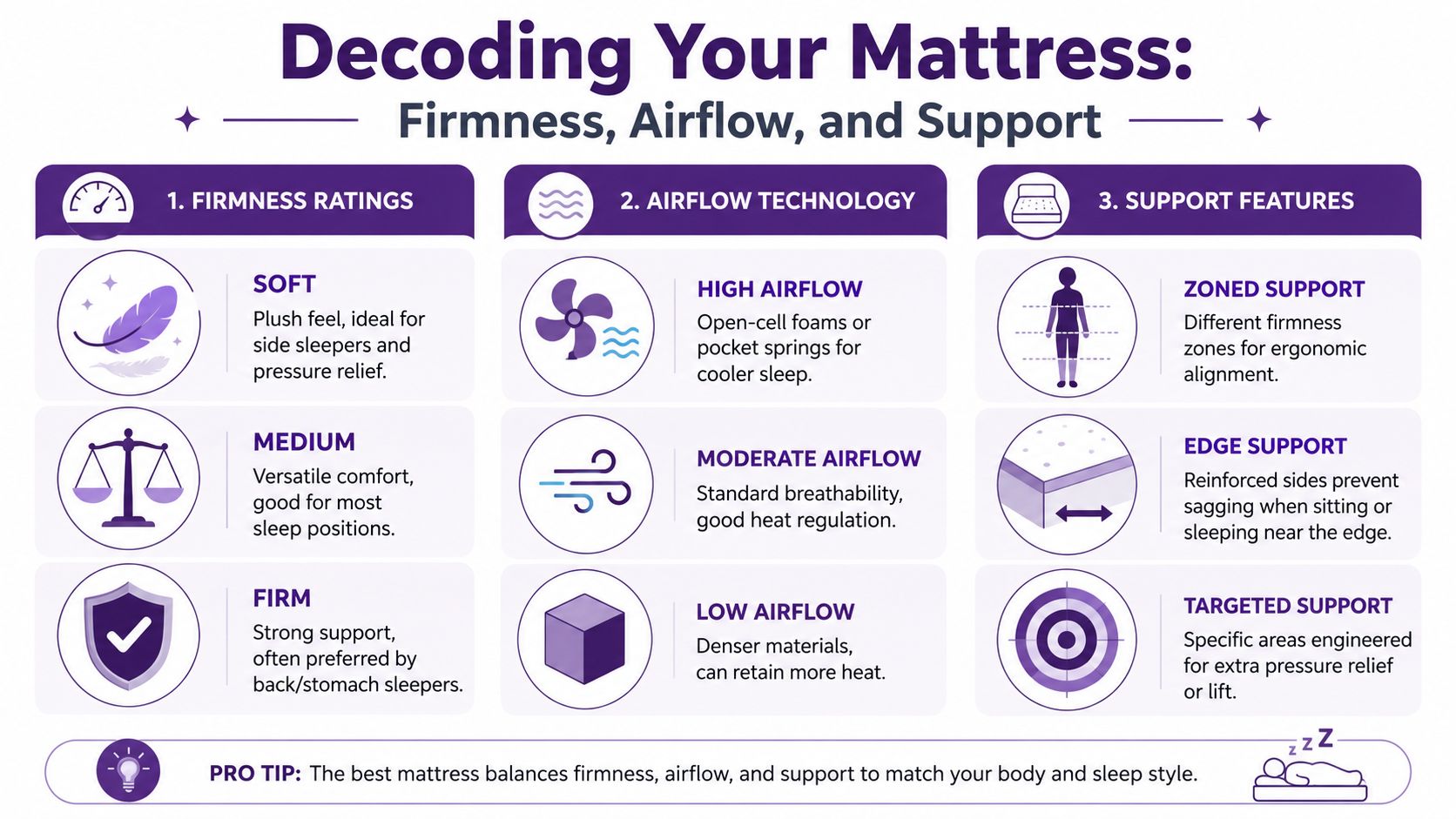
Reading firmness without overthinking it
Firmness labels matter, but only if you treat them as a starting point rather than a verdict. One brand's medium can feel noticeably firmer than another's because the layers underneath do different jobs. A hybrid with springs underneath can feel more buoyant and supportive than an all-foam mattress with the same label, which is one reason hybrids often suit UK shoppers who want pressure relief without the “stuck” feeling.
A simple guide helps:
- Softer feels: Often suit side sleepers who need more cushioning at the shoulders and hips.
- Medium feels: Usually suit combination sleepers who change position and want a mix of comfort and pushback.
- Firmer builds: Often suit back sleepers, heavier bodies, or anyone who wants less sink through the middle of the mattress.
Body weight changes the feel too. A lighter person may find a medium-firm mattress fairly solid, while a heavier person may press through the top layers more and experience the support core sooner. If you want a clearer way to match labels to your build and sleep position, this mattress firmness guide for different sleep styles and body types is a useful reference.
What airflow features actually do
Cooling features are often described as if one material solves the whole problem. Real heat control works more like a system with several parts. If the comfort layer holds heat, the mattress can still feel warm even with a breathable cover. If the cover feels cool at first touch but the core traps warmth, that cool feeling fades quickly.
That is why hybrids often have an advantage over the all-foam stereotype many bed-in-a-box shoppers start with. Springs create open space inside the mattress, which gives warm air more room to move. Foams can still add pressure relief on top, but the support core is no longer a solid slab that holds onto more heat.
When you compare options, look for three things:
- Breathable comfort layers: These reduce that dense, close feeling around the body.
- A spring core: This usually improves internal air movement.
- A cover designed for temperature regulation: Useful, but only as the final layer in the chain.
Cooling works as a system. If one layer traps heat, the mattress can still sleep warm.
This matters most for people who wake up sweaty at the lower back or chest, or who throw a leg out from under the duvet to cool down. In those cases, a hybrid build often fixes the root problem better than adding “cooling” accessories to an all-foam mattress.
Support features that deserve attention
Support is where a mattress proves itself after the first few nights. The top can feel lovely in a showroom or on day one at home, but the deeper structure decides whether you wake up comfortable or stiff.
A few features deserve more attention than flashy cooling names:
- Pocket springs: These react more independently than a single connected spring unit, so the mattress can respond better to your shape.
- Zoned support: This gives different parts of the mattress different levels of pushback. It can help if your hips are heavier than your shoulders or if your lower back needs steadier support.
- Edge support: Stronger edges matter if you sit on the side to get dressed, share a smaller bed, or sleep near the edge.
- Motion isolation: This helps if your partner rolls over, gets up early, or has a different sleep schedule.
For back pain, zoning and spring response often matter more than a simple “firm” label. A mattress should let the shoulders and hips settle enough to avoid pressure build-up while still keeping the waist and lower back from sagging. That balancing act is one of the main reasons hybrid bed-in-a-box models are often a better fit for sleepers who need both comfort and structure.
You may also notice older reviews using different REM-Fit model names than current listings. The former 400 is now the 3000 Supreme. The former 500 Ortho is now the 4000 Ortho Lux Elite. The former 600 Lux is now the 5000 Lux Elite. If review names do not match the product page, that renaming is often the reason.
Your Essential Pre-Purchase Checklist
Buying a mattress online can go wrong in a very ordinary way. The mattress arrives, the top layer feels pleasant enough, then a week later you realise the returns process is confusing, the care rules are buried, and getting help feels harder than choosing the mattress in the first place.
That is why the checklist matters. A good hybrid bed in a box is not only about springs, foam, or cooling covers. It is also about how safely you can test it in your own room, with your own pillow, after a few nights of real sleep.
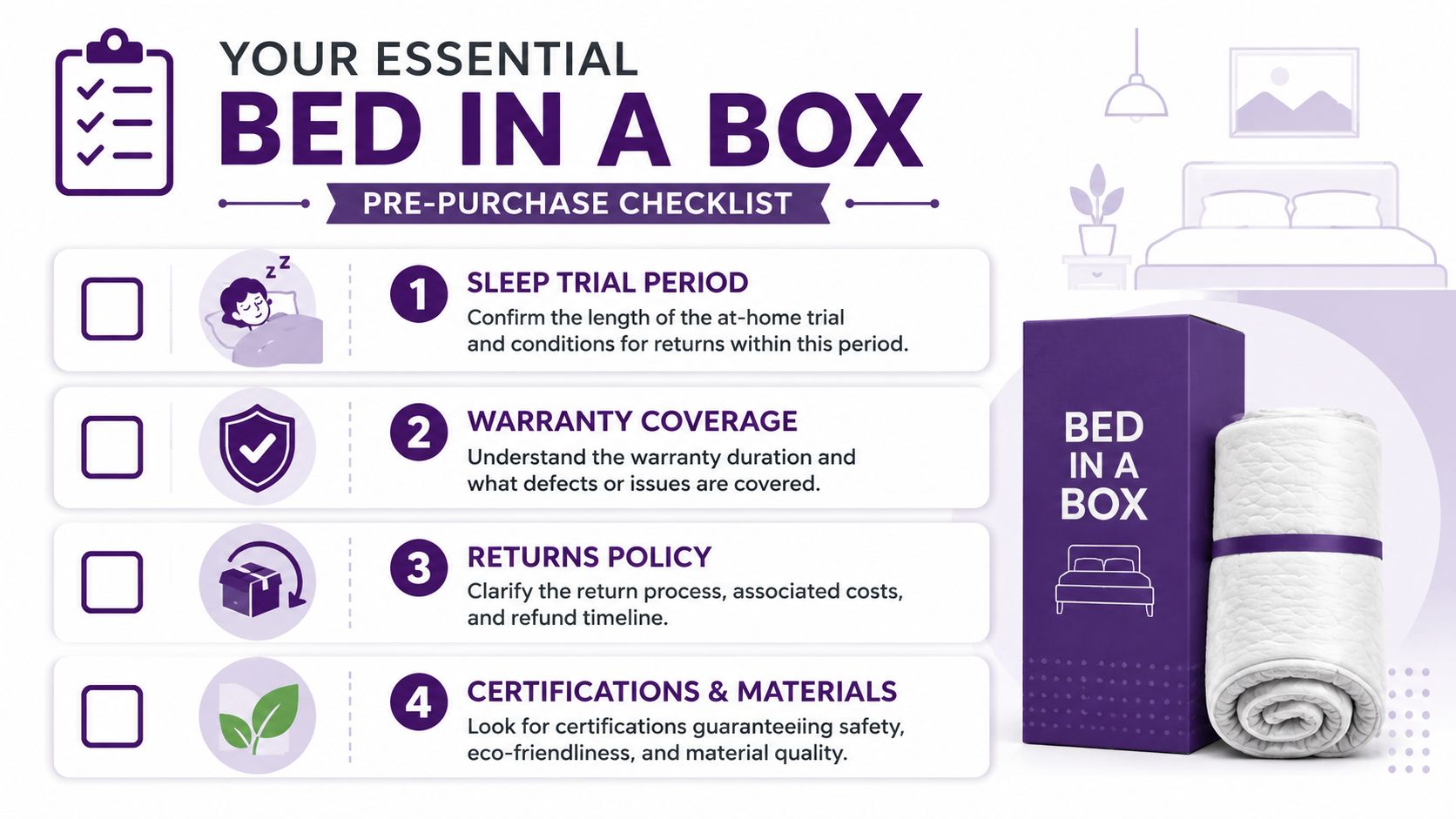
The four checks that matter most
- Sleep trial
A mattress is a bit like a new pair of walking shoes. The first few hours tell you something, but not enough. You need time to see how it handles your normal routine, especially if you are moving from an older mattress that let your hips sink or trapped too much heat.
For UK buyers choosing a hybrid bed in a box for back pain or overheating, this matters even more. You are not only judging softness. You are checking whether the spring support keeps your spine steadier and whether the surface stays comfortable through the night.
- Guarantee
A guarantee does not prove that a mattress will suit your body. It does show how the brand deals with faults and longer-term wear.
Read the wording carefully. Look for what is covered, what counts as normal settlement, and whether the process sounds clear or full of exclusions.
- Returns process
Many good-looking mattress deals can prove stressful. Check who arranges collection, whether you need to keep the packaging, and whether there are minimum trial periods before a return is accepted.
If the returns page is hard to follow, assume the process may be hard to follow later too.
- Material clarity
You should be able to tell what is inside the mattress. “Cooling comfort” or “pressure relief” sounds nice, but those phrases are too vague on their own.
A serious product page should explain the layers in plain English. For a hybrid model, that means knowing what kind of foam sits on top, whether there are pocket springs underneath, and whether there are practical details such as edge support or zoning. That information helps you judge whether the mattress is likely to help with specific problems instead of asking you to buy on marketing language alone.
A useful benchmark
As noted earlier, REM-Fit's current range includes the 3000 Supreme, 4000 Ortho Lux Elite, and 5000 Lux Elite. The useful lesson is not a specific promise or policy. It is the standard of clarity you should expect from any brand selling a hybrid bed in a box.
You should be able to find clear answers on trial terms, returns, materials, and aftercare without hunting through multiple pages. You should also be able to find practical ownership advice, such as this guide on how to care for your new mattress, because maintenance affects how well the mattress performs over time.
Read the returns page with the same attention you give the comfort layer. Both affect whether the purchase feels smart a month later.
One final check saves a lot of frustration. Confirm delivery access, room setup, and old mattress removal before you order. For many UK homes, especially flats, terraces, or narrow staircases, logistics can be the part that causes the most trouble.
Unboxing and Surviving the First 30 Nights
You cut away the plastic, the mattress opens up, and your first thought is often, "That's it?" A boxed mattress can look underwhelming on day one. The surface may seem a little uneven, the corners may not look fully formed, and the feel can be softer or firmer than you expected in those first few hours.
That early impression is often misleading.
A bed in a box has spent time compressed and rolled. With hybrid models, both the foam comfort layers and the spring unit need time to rise into shape. It works a bit like opening a tightly packed winter coat after it has been vacuum-sealed. The materials need air and a little time before they perform as intended. Sleeping on it too quickly will not usually ruin it, but it can make the first night a poor test of support, especially if you bought a hybrid for back pain or cooler sleep.
What to do on day one
Set it up where it will stay. Once a mattress has expanded, moving it through a narrow hallway or up a tight staircase is much harder.
Then keep the first setup simple:
- Remove all packaging carefully: Avoid cutting too deep near the cover.
- Let it breathe: Open a window and give the materials time to air out and settle.
- Put it on the right base: A solid platform or supportive slats help the mattress sit evenly.
- Hold off on heavy bedding at first: A thick topper or dense duvet can trap heat and make the initial feel harder to judge.
A mild new-mattress smell can happen, especially if the comfort layers include foam. In most bedrooms, fresh air clears that faster than sprays or scented products.
How to judge the trial period fairly
The first 30 nights are less about instant comfort and more about pattern recognition. Your body has muscle memory. If your old mattress sagged, your shoulders, hips, and lower back may have been compensating for months or years. A better mattress can feel unfamiliar before it starts to feel supportive.
This matters even more with hybrids. If you chose one because you overheat or wake with back pain, the benefits can show up gradually. You might notice fewer early-morning heat spikes, less stiffness when you get out of bed, or better support when you roll from your side to your back. Those are more useful signs than a dramatic opinion after one night.
The real question is whether your sleep is improving.
Keep notes for a couple of weeks if you tend to second-guess big purchases. Nothing fancy. Just track how often you wake up, whether you feel hot, and how your back or shoulders feel in the morning. That makes it easier to separate a short adjustment period from a mattress that genuinely is not right for you.
For simple habits that protect the mattress while you test it, this guide to caring for your new mattress is a useful reference.
One more point gets missed a lot. Your pillow can distort the whole trial. If your mattress is breathable but your pillow traps heat, you may blame the bed for a problem that starts higher up. If your new hybrid seems supportive through the torso but your neck still aches, the mattress may not be the weak link.
Give the mattress a fair test, but pay attention to the full sleep setup around it.
Finding Your Perfect Match and Next Steps
The smartest way to shop for a bed in a box in the UK is to stop thinking about the box and start thinking about the build. Delivery method is the easy part. What changes your sleep is the combination of support, pressure relief, airflow, and enough trial time to judge it properly.
Hybrid models usually make the most sense for sleepers with more specific needs. If you have back pain, the spring support core can provide a steadier base than many all-foam designs. If you sleep hot, airflow through the core and breathable comfort materials can make the bed feel less enclosed. Add a cooling pillow to the setup and you've got a more complete sleep system, especially if your head and neck are where heat tends to build up.
Keep the final decision simple. Check the construction. Match the firmness feel to your sleep position. Read the trial and guarantee terms closely. And if older reviews mention different model names, remember that the 400 is now the 3000 Supreme, the 500 Ortho is now the 4000 Ortho Lux Elite, and the 600 Lux is now the 5000 Lux Elite.
If you want to compare hybrid mattress options, cooling sleep accessories, and practical buying terms in one place, REM-Fit is one UK sleep brand worth reviewing as part of your shortlist.